

On Tuesday, 25 November, the auction houses Artcurial and Millon will have the honour of offering at auction an exceptional rediscovery: David Contemplating the Head of Goliath by Guido Reni, a masterful seventeenth-century work that has been missing for over two centuries (estimate: € 2,000,000 - 4,000,000).
This version, of rare dramatic intensity, once belonged to Francesco I d’Este, Duke of Modena (1610–1658), who acquired it directly from the artist, and later to Prince Eugenio of Savoy (1663–1736), the illustrious generalissimo of the Empire, defender of Christendom, and architect of the Belvedere Palace in Vienna.
Upon Prince Eugenio’s death, much of his prestigious collection was purchased in its entirety by his nephew, Carlo Emanuele III of Savoy, and placed in his royal palace in Turin. During the French conquest of Italy in the final years of the 18th century, the painting was brought back to France in the luggage of General Pierre-Antoine Dupont de l’Étang, before disappearing for nearly 230 years—only to be rediscovered today among his descendants.
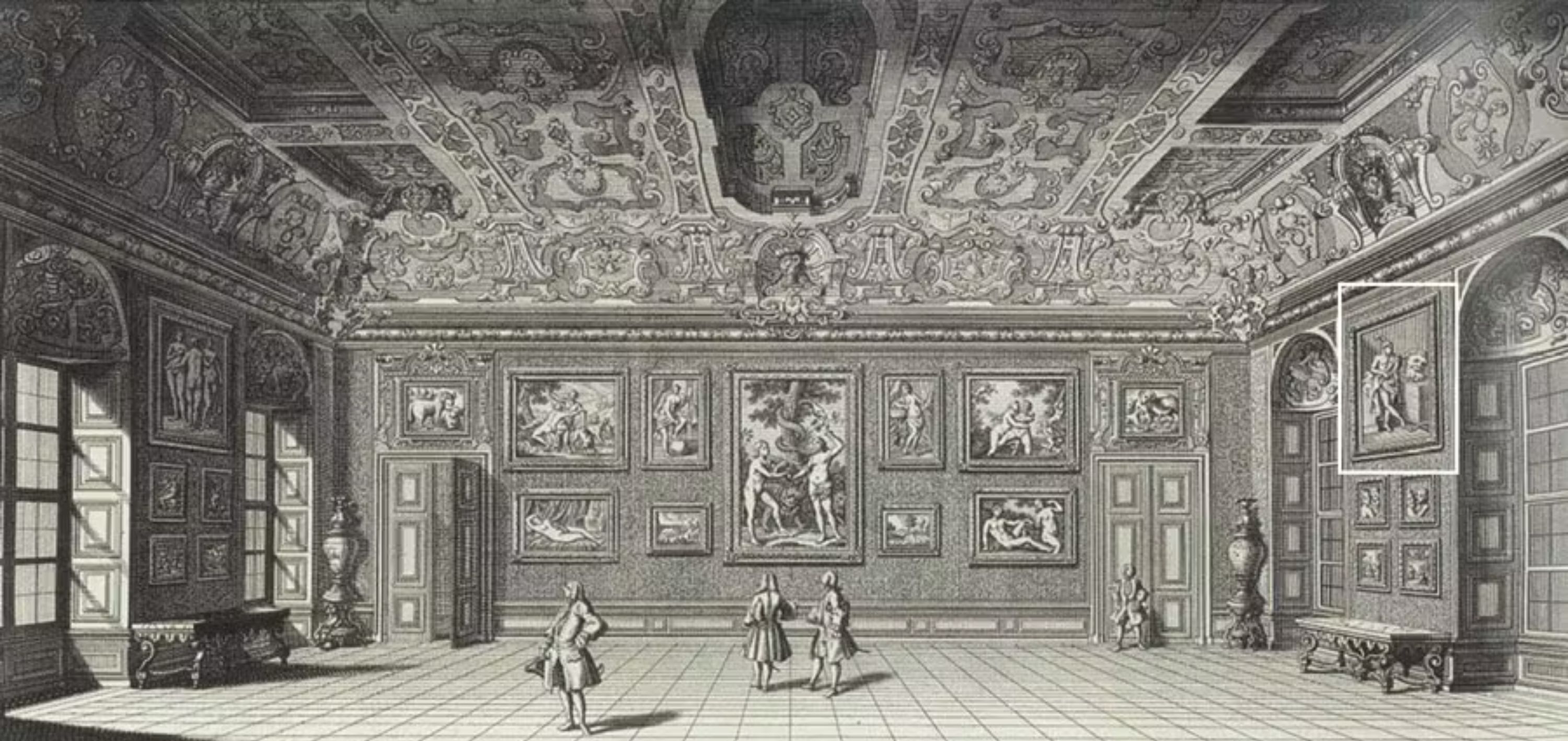
Engraved view of the Belvedere Palace in Vienna in 1734,
where David contemplating the head of Goliath by Guido Reni is displayed.
Guido Reni’s lost masterpiece: a turning point between classicism and baroque
With this work, around 1605–1606, Guido Reni reshaped the Roman painting scene. Late Mannerism, championed by the pupils of Girolamo Muziano and the Cavaliere d’Arpino, was still dominant, even as two realist currents were emerging at the vanguard: Caravaggio’s dramatic naturalism, already on display in the Contarelli and Cesari chapels, and the balanced Classicism of the Carracci, authors of the Farnese Palace ceiling.
Reni’s David marks a crucial stage in the stylistic evolution of the artist, a leading figure of the Bolognese school. The young hero, depicted with delicate features and an almost androgynous elegance, appears thoughtful and composed, far from any triumphalism, highlighting the tension between gentleness and violence. While influenced by Caravaggio in the raw realism of Goliath’s head and the strong chiaroscuro, Reni stands out for his ideal of harmonious beauty, with a balanced composition and a soft, enveloping light that caresses the forms. This Bolognese Classicism, heir to the Carracci Academy, seeks to ennoble religious or historical subjects with formal restraint and moral elevation. Reni’s work embodies the fertile tension between the two great strands of seventeenth-century Italian art: Caravaggesque naturalism and the classical ideal.

Guido RENI (Bologna, 1575–1642)
David Contemplating the Head of Goliath
Oil on canvas 227 × 145,5 cm
Estimate: € 2.000.000 - 4.000.000
The iconographic variations of Guido Reni’s David
The canvas belongs to the so-called “Créquy” typology, recognisable by Goliath’s head turned outward. This classification was proposed by Corentin Dury, who studied and distinguished the variations in Guido Reni’s David iconography. The name derives from Charles III de Créquy, Louis XIV’s ambassador to Rome and owner of the version now held in the Louvre. The composition of our canvas and that of the Paris museum is almost identical, with slight differences reflecting the freedom the artist allowed himself in producing the various autograph replicas.
The La Vrillière typology, with Goliath’s head turned inward, is named after the collector Louis Phélypeaux de La Vrillière, who owned the most important collection of Italian paintings in Paris after that of King Louis XIV, and the version of David now recognised as autograph and currently held at the Musée des Beaux-Arts in Orléans. This latter version gave rise to workshop copies preserved in Florence (Galleria degli Uffizi), Dresden (Gemäldegalerie Alte Meister), and Osnabrück (Kulturgeschichtliches Museum).
Practical information
Auction: Tuesday, 25 November 2025 – Artcurial
Exhibition: From Friday, 21 to Monday, 24 November 2025 (11:00 am – 6:00 pm)
Artcurial, 7 Rond-Point des Champs-Élysées Marcel-Dassault, 75008 Paris.
Expertise: Cabinet Turquin.
----------